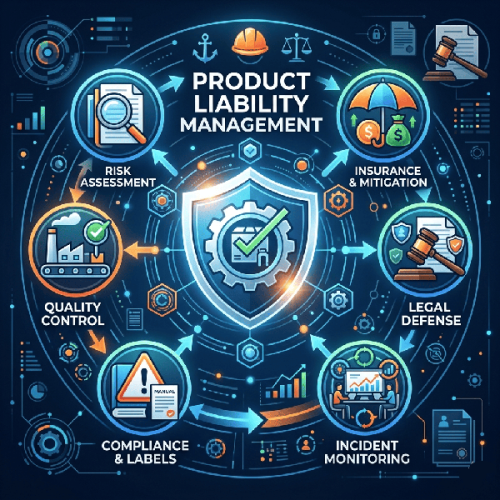
Product Liability Management is the strategic process of minimizing a company’s legal and financial risk arising from claims that a product caused injury, death, or property damage. For manufacturers, especially those in sectors like food, electronics, or equipment, a single claim can be catastrophic to both the balance sheet and the brand.
Effective management focuses on three primary types of defects: Manufacturing Defects, Design Defects, and Marketing Defects (Failure to Warn).
1. The Three Pillars of Risk Prevention
A. Design Safety
Risk management starts before the first unit is produced.
-
Safety Reviews: Conducting Hazard Analysis and Critical Control Point (HACCP) for food or Failure Mode and Effects Analysis (FMEA) for technical products.
-
Standards Compliance: Ensuring the design meets or exceeds industry standards (e.g., BIS in India, CE in Europe, UL in the USA).
-
Redundancy: Building in safety backups to prevent a single point of failure from causing harm.
B. Quality Control (Manufacturing)
Even a perfect design can fail if the execution is flawed.
-
Batch Testing: Regular sampling of production lots to ensure they meet specifications.
-
Supplier Audits: Verifying that your raw material suppliers (e.g., providers of organic ingredients or components) maintain the same quality standards as your facility.
-
Calibration: Keeping all testing equipment precise to prevent false "pass" results.
C. Marketing and Warnings
You are legally responsible for how a consumer uses your product.
-
Clear Instructions: Providing easy-to-read manuals that define the "intended use."
-
Warning Labels: Placing visible warnings about foreseeable misuses (e.g., "Keep away from open flame").
-
Disclaimers: Using legally vetted language to limit liability for unauthorized modifications.
2. Post-Market Surveillance & Traceability
Managing liability doesn't end when the product leaves the warehouse. You must be able to act quickly if a flaw is discovered later.
-
Complaint Monitoring: Tracking customer feedback for "signals" of recurring safety issues.
-
Traceability Systems: Utilizing batch codes or QR codes to identify exactly which units are affected. If a specific lot of organic snacks has a contamination issue, you should be able to isolate that batch without recalling your entire inventory.
-
Recall Readiness: Having a pre-written "Product Recall Plan" so your team knows exactly how to notify regulators, distributors, and consumers within 24–48 hours.

krishna
Krishna is an experienced B2B blogger specializing in creating insightful and engaging content for businesses. With a keen understanding of industry trends and a talent for translating complex concepts into relatable narratives, Krishna helps companies build their brand, connect with their audience, and drive growth through compelling storytelling and strategic communication.